

In industry today, efficiency is a constant operational necessity. That is why at Comeval we highlight the CONA® All-in-One from Diaval – Comeval, a solution that redefines installation and maintenance standards in steam systems by integrating multiple functions into a single, superbly engineered unit.
From conventional installation to full integration
The main challenge with traditional drain units is their physical complexity and the number of critical joints. A standard system usually consists of five individual components: two shut-off valves, a strainer, a check valve and the steam trap. This assembly typically takes up a total length of 662 mm and requires up to six flanged connections.
By contrast, this compact solution brings all these elements together in a single body of just 160 mm. This drastic reduction in space makes it easier to design new plants and allows upgrades in older installations where space is extremely limited, significantly reducing both the installation effort and the space required.
Real optimisation of maintenance and operational safety
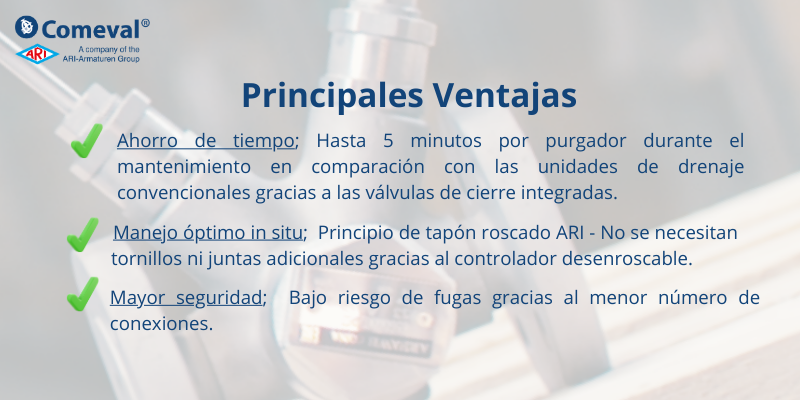
The architecture of this system is designed specifically to maximise the productivity of maintenance teams. With two integrated shut-off valves, which can be configured with bellows or gland packing sealing, inspection work is speeded up dramatically. It is estimated to save up to five minutes per steam trap during interventions compared with conventional units. In addition, the ARI threaded plug removes the need for extra bolts or gaskets to reach the controller, allowing much quicker handling on site thanks to its screw-out controller.
Versatility is another of its great strengths, since the unit allows four different control elements to be interchanged: bimetallic, thermostatic, thermodynamic or ball float. This means that the same installation can be adapted to different process conditions simply by changing the internal controller. Safety is reinforced by the very nature of the design: with fewer connections, the risk of leaks is markedly reduced, which translates into greater energy efficiency and a safer working environment.